Custom AI development helps businesses build AI solutions around their specific data, workflows, systems, and operational requirements. Although generic AI solutions can prove to be helpful for experimenting, sometimes it is necessary to have something more integrated into the business operations.
The most important question in this case is not what kind of AI solution is needed, but which business problem deserves an AI solution.
What Is Custom AI Development?
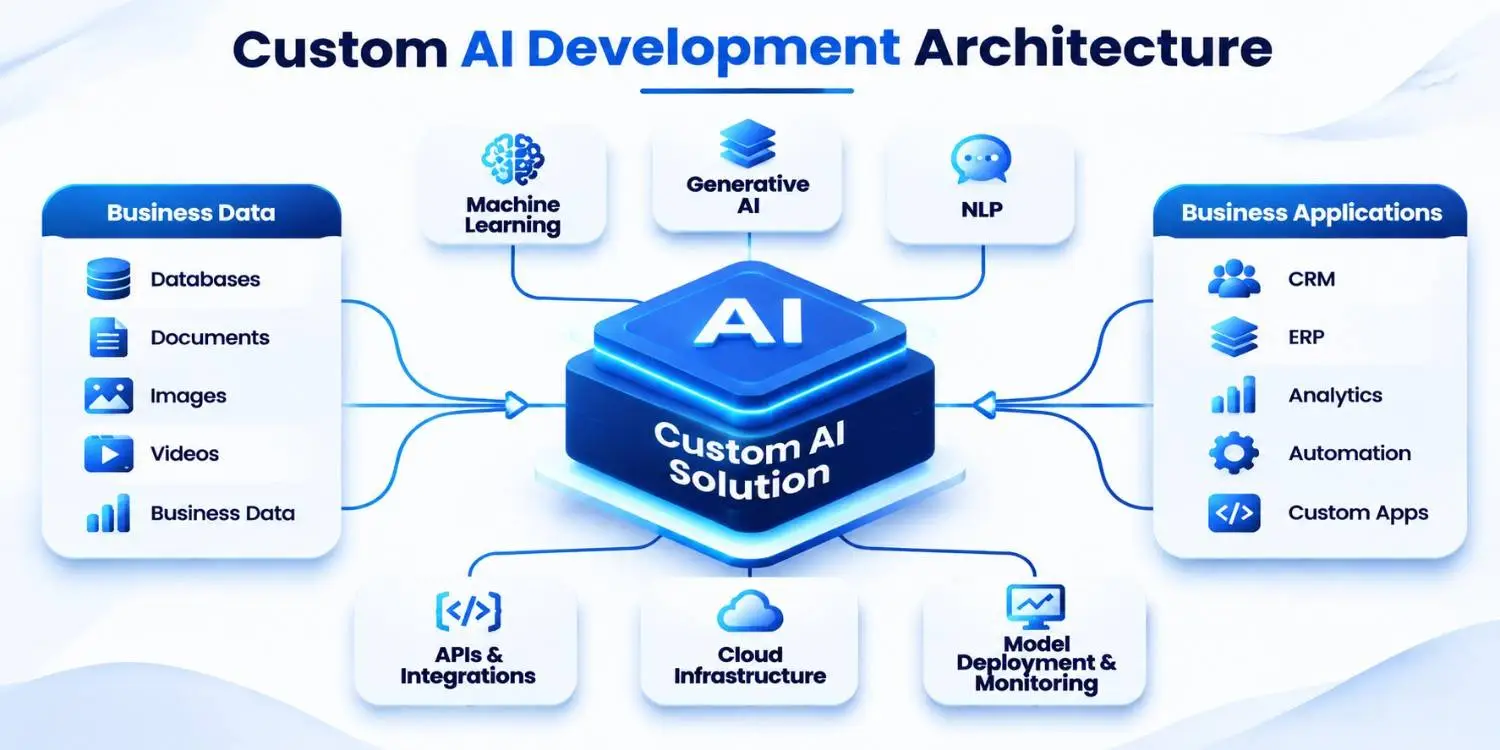
Custom AI development is the process of designing, building, integrating, and maintaining AI solutions for specific business requirements. Custom AI software development can involve machine learning, generative AI, natural language processing (NLP), computer vision, predictive analytics, and large language models (LLMs), depending on the problem being solved.
“Custom” does not necessarily mean training a proprietary model from scratch. Often, the better architecture combines an existing foundation model with company data, retrieval-augmented generation (RAG), business rules, APIs, and permissions.
For example, a professional services firm could build a system that searches approved internal documents, respects employee permissions, returns source-backed answers, and routes uncertain cases for review.
When Does a Business Need Custom AI Development?
Businesses may need bespoke AI development when off-the-shelf tools cannot adequately support their workflows, proprietary data, integrations, security requirements, or desired level of control.
Common signals include:
- Important decisions depend on proprietary or domain-specific data.
- Existing AI tools cannot connect cleanly with core software.
- The workflow includes custom rules, approvals, or exceptions.
- AI needs to operate inside an existing product.
- Accuracy, privacy, auditability, or scalability requirements are unusually high.
A logistics company, for instance, may need a system that combines order history, warehouse capacity, carrier status, and delivery performance to flag at-risk shipments and alert the right team.
When You Should Not Build Custom AI
If a mature SaaS product already solves most of the requirement, meets security needs, and integrates with your stack, buying may be faster and cheaper.
A useful rule is:
Buy when the workflow is common and differentiation is low.
Customize when an existing platform is close but needs company-specific integrations.
Build when workflow, data, control, or product experience is strategically important.
Custom AI vs. Off-the-Shelf AI Solutions
Custom AI offers greater control and business fit, while off-the-shelf AI usually provides faster deployment and lower upfront cost.
| Factor | Custom AI Solution | Off-the-Shelf AI |
|---|---|---|
| Business fit | Built around specific workflows | Designed for broad use cases |
| Time to launch | Requires discovery and development | Usually faster |
| Upfront cost | Higher | Lower |
| Customization | Extensive | Limited |
| Integration | Designed around existing systems | Depends on vendor support |
| Data control | Greater architectural control | Depends on vendor policies |
| Best suited for | Strategic or complex requirements | Standardized tasks |
How the Custom AI Development Process Works
Strong custom AI development starts with discovery, not model selection.
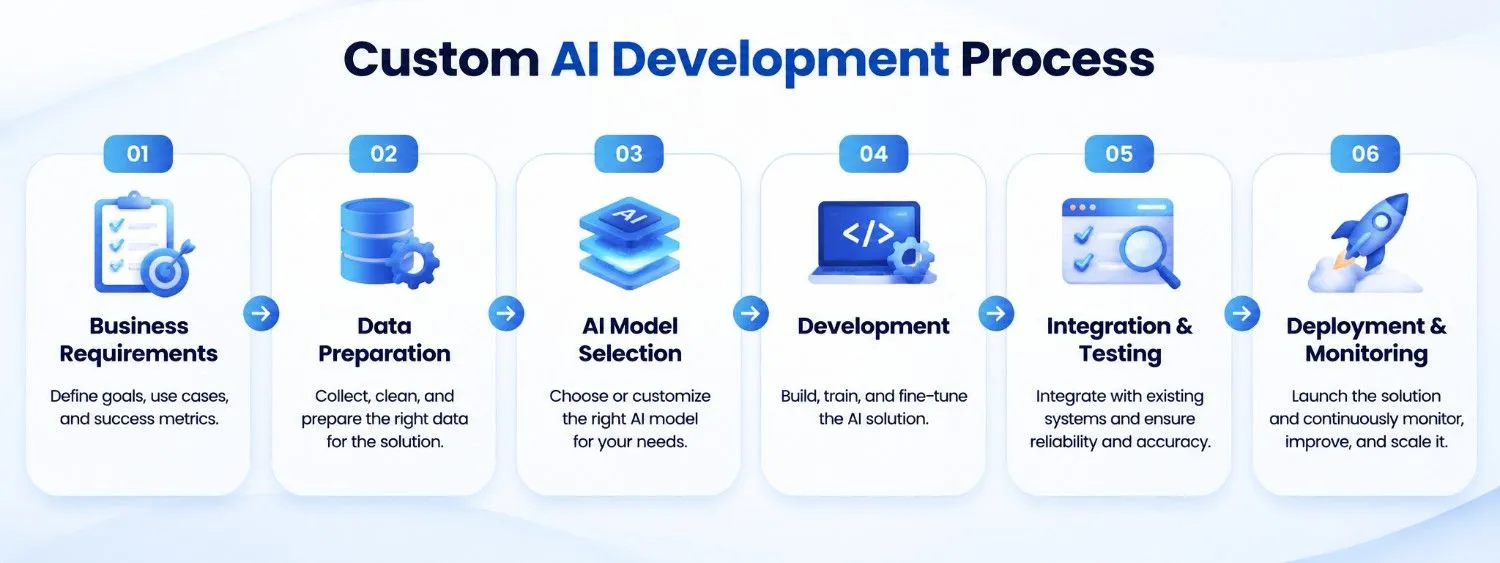
1. Define the Business Problem
“We want an AI assistant” is vague. “We want account managers to find approved client information without searching five systems” is actionable.
Define the user, workflow, bottleneck, baseline, and desired result. Useful metrics may include time per task, resolution rate, error frequency, or adoption.
2. Assess Data and Technical Requirements
Review what data exists, where it lives, how reliable it is, who can access it, and which systems the AI must read from or write to.
This step often changes the architecture. Organized internal knowledge may support RAG, while fragmented data may reveal that data infrastructure is the real obstacle.
3. Choose the Simplest AI Approach That Works
Predictive machine learning may fit forecasting, computer vision may support inspection, NLP can classify documents, and generative AI can summarize, draft, or search knowledge.
Some workflows benefit from greater autonomy. AI agents for business can coordinate multiple steps and interact with tools, but more agency also creates more permissions and failure paths.
If a simpler model or conventional automation can solve the problem reliably, extra complexity only adds cost and maintenance.
The right approach may involve custom AI model development, an existing foundation model, or a combination of machine learning and conventional software automation.
4. Prototype the Riskiest Assumption
A prototype should answer a business question, not merely prove that a model works.
Can the system access the right data? Is the output accurate enough? Does it save meaningful time? Test with representative data and edge cases rather than a polished demo alone.
5. Develop and Integrate the Production System
Once the concept is validated, the team may need data pipelines, APIs, authentication, permissions, interfaces, logging, and integrations.
This is why broader AI development services matter. The model may generate an answer, but software engineering and data architecture determine whether it reaches the right user safely.
For repetitive operations, AI automation can connect AI decisions with CRMs, ERPs, helpdesks, databases, and internal applications.
6. Test Accuracy, Security, and Failure Behavior
Production AI should be tested beyond ideal prompts. Evaluate accuracy, permissions, data exposure, latency, edge cases, and what happens when the model is uncertain.
For LLM and agentic systems, test prompt injection, sensitive-data exposure, overly broad tool permissions, and unsafe autonomous actions. Higher-impact actions should have tighter controls and human approval. OWASP’s current GenAI security guidance specifically highlights risks including prompt injection, sensitive information disclosure, excessive agency, and weaknesses affecting vector and embedding systems.
7. Deploy, Monitor, and Improve
Deployment is the start of operational ownership. Track model quality, response times, errors, usage costs, user behavior, and the business metric the solution was built to improve. Monitoring should be part of the system design.
What Makes Custom AI Development Different in 2026?
In 2026, custom AI development is less about gaining access to a capable model and more about designing a dependable system around it.
Businesses can choose among foundation models, smaller specialized models, retrieval architectures, automation tools, and agentic systems. That flexibility makes architecture, governance, and security decisions more important.
AI risk management is also becoming an important part of production development. NIST's AI Risk Management Framework provides guidance for identifying and managing risks throughout the AI lifecycle.
The practical takeaway: model capability is only one part of production readiness. Data access, permissions, evaluation, observability, and human oversight matter just as much.
How to Choose the Right AI Solution for Your Business
Choosing the right custom AI solution requires evaluating your business objectives, data availability, workflows, technology stack, budget, and risk requirements.
Before approving custom AI development, ask:
- What measurable result should improve?
- Is the required data reliable and accessible?
- Which systems must it connect with?
- Which actions can AI perform safely?
- Where is human approval required?
- What level of accuracy is acceptable?
- Who owns the system after launch?
A SaaS company may initially ask for a support chatbot. After mapping the workflow, the higher-value solution might be a copilot that retrieves account context, searches approved documentation, drafts a response, and escalates unusual cases to an agent. The problem definition changes the product.
What Affects Custom AI Development Costs?
The cost of custom AI development depends mainly on complexity, data preparation, model choice, integrations, infrastructure, security, testing, and ongoing operation.
| Project level | Typical characteristics | Examples |
|---|---|---|
| Lower complexity | Existing models/APIs, limited integrations | Summarization, classification, internal search |
| Medium complexity | Proprietary data, RAG, multiple integrations | Knowledge assistants, support copilots |
| Higher complexity | Custom models, real-time decisions, strict controls | Predictive platforms, computer vision, agentic systems |
The model may not be the biggest expense. Data cleaning, integrations, evaluation, UI development, security controls, infrastructure, monitoring, and maintenance all affect total cost.
A better budgeting question is: What will this system cost to build, operate, monitor, and improve at the usage level we expect? Starting with one high-value workflow can reduce risk before expanding.
Common Custom AI Development Mistakes to Avoid
- Starting with technology instead of a business outcome. Define the problem before choosing the model.
- Building on unreliable data. Poor data quality or permissions can undermine a strong system.
- Automating a broken process. Remove unnecessary steps before automating them.
- Giving AI too much autonomy. Use minimum permissions and human approval for high-impact actions.
- Underestimating integration work. AI creates value when it fits into existing systems.
- Skipping evaluation criteria. Define what “good enough” means before development.
- Treating launch as completion. Production AI needs monitoring and maintenance.
How to Choose a Custom AI Development Partner
Choosing a custom AI development partner requires evaluating its experience in AI engineering, machine learning, data architecture, software integration, security, and production deployment. The right team should understand your business requirements and recommend an AI solution that fits your technical and operational needs.
Look for a team that connects product strategy, data engineering, AI engineering, security, integration, deployment, and support. Ask:
- What would you validate before committing to the full project?
- Which parts actually require AI?
- When would you use an existing model instead of training one?
- How will output quality and failure cases be measured?
- How will sensitive data and permissions be controlled?
- How will operating costs be estimated?
- What monitoring is required after launch?
Good answers should be specific to your workflow.
Zensol Global Technologies provides AI development, machine learning, natural language processing, and automation services designed to integrate with existing business workflows and systems.
Final Thoughts
The best custom AI development projects do not begin with a model. They begin with a workflow where better decisions, faster execution, or less manual work can create measurable value.
Start with one clear problem. Confirm the data exists. Choose the simplest architecture that meets the requirement. Test it with real users and realistic failure cases before scaling, then plan for integration, security, monitoring, maintenance, and operating cost from the start.
Custom AI is most valuable when generic software forces meaningful compromises in workflow, control, data use, or product experience. When those conditions are present, a tailored system can become part of how the business operates rather than another disconnected AI experiment.
If you are evaluating where AI could create that kind of value, you can discuss your AI project with Zensol Global Technologies and explore a practical route from problem definition to production.