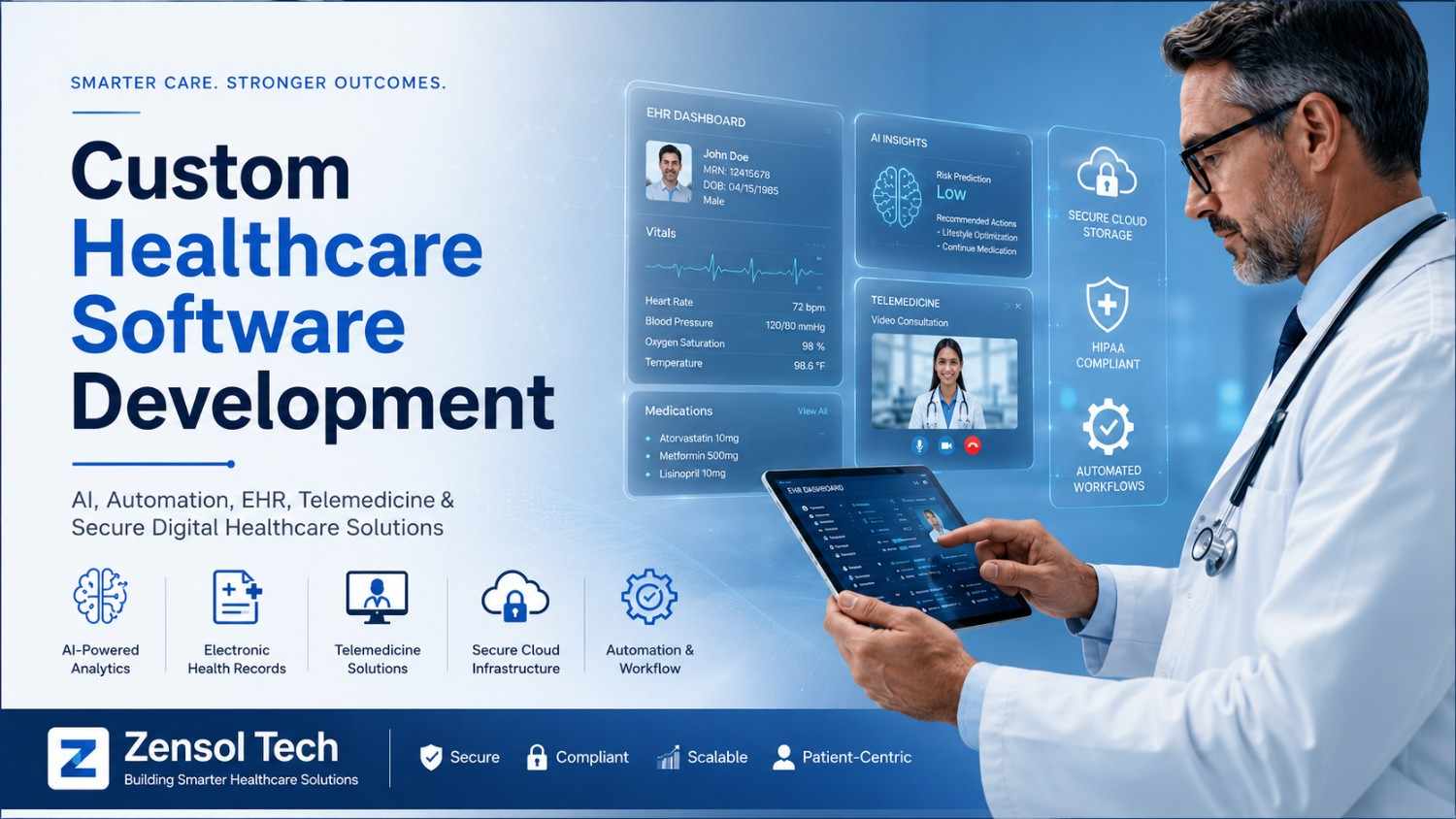
Custom healthcare software development has become a key part of healthcare modernization. Hospitals, clinics, diagnostic labs, healthcare startups, and medical service providers now need digital systems that are secure, connected, scalable, and easy to use.
In 2026, healthcare organizations are no longer looking for basic software. They need solutions that improve patient care, reduce administrative delays, protect sensitive health data, support compliance, and help clinical and operational teams make faster decisions.
Many providers still rely on outdated platforms, manual workflows, disconnected portals, and systems that cannot communicate with each other. These limitations slow down daily operations, make patient records harder to access, delay billing, create coordination gaps between departments, and force staff to spend too much time on repetitive administrative tasks.
Custom healthcare software solves these problems by building technology around the actual workflows of a healthcare organization. Instead of forcing doctors, nurses, administrators, and patients to adapt to generic software, a custom system is designed around their real needs, processes, and long-term growth goals.
At Zensol Tech, we build secure, scalable, and AI-ready healthcare software that helps organizations modernize operations, improve patient experience, and prepare for the future of digital healthcare.
What is Custom Healthcare Software Development?
Custom healthcare software development is the process of designing, building, and deploying digital solutions tailored to the needs of healthcare organizations. These solutions are created for specific clinical workflows, users, departments, integrations, compliance requirements, and long-term growth goals.
Unlike off-the-shelf software, custom healthcare platforms are built around how an organization actually works. They can support hospitals, clinics, telemedicine providers, labs, healthcare startups, insurance platforms, and enterprise healthcare networks with systems such as patient portals, hospital management software, EHR/EMR integrations, telemedicine platforms, billing systems, healthcare CRM tools, mobile apps, and AI-powered analytics.
A strong custom healthcare system does more than store patient data. It connects patients, providers, departments, and digital systems in one secure environment, helping healthcare teams reduce errors, work faster, improve coordination, and deliver better patient care.
Why Healthcare Organizations Need Custom Software in 2026
Healthcare is becoming more digital, connected, and data-driven. Patients expect faster access to care, staff need simpler workflows, leaders need clearer operational visibility, and regulators expect stronger data protection. Healthcare systems also need to connect securely with labs, pharmacies, payers, imaging platforms, EHR systems, and patient-facing apps.

Custom healthcare software helps organizations meet these demands by building secure, flexible, and workflow-specific systems that improve daily operations and support better care delivery.
1. Better Clinical Efficiency
Disconnected systems slow down doctors, nurses, and administrative teams. A custom platform can bring patient records, appointments, clinical notes, billing, reporting, and communication into one connected workflow. This reduces duplicate work, improves coordination, and gives staff more time for patient care.
2. Improved Patient Experience
Patients now expect healthcare to be simple, fast, and accessible. Custom patient portals and mobile apps allow them to book appointments, receive reminders, access reports, message providers, pay bills, and manage health information securely.
3. Stronger Data Security
Healthcare software manages highly sensitive patient data. Custom systems allow security to be built in from the start through secure login, encryption, role-based access, audit logs, backups, and protected API integrations.
4. Better Interoperability
Modern healthcare platforms must exchange data across EHRs, labs, pharmacies, imaging systems, insurance platforms, payment gateways, and patient apps. Custom software can be designed around standards such as FHIR, HL7, DICOM, X12, SMART on FHIR, and secure healthcare APIs.
5. AI and Automation Readiness
AI can support healthcare analytics, documentation, workflow automation, patient engagement, and decision support. Custom healthcare software can be built with clean data structures, secure architecture, and proper governance so organizations can safely add AI-powered features over time.
To better understand how these systems are structured and implemented, let’s explore their key features.
Key Features of Custom Healthcare Software
The right features depend on the size, specialty, and workflow of each healthcare organization. However, most custom healthcare software platforms need to support both clinical and administrative operations, from patient management and appointments to billing, integrations, security, and analytics.
| Feature Area | What It Does | Why It Matters |
|---|---|---|
| Patient Management | Manages patient profiles, medical history, appointments, documents, prescriptions, and follow-ups | Gives healthcare teams a centralized view of each patient |
| Patient Portal | Allows patients to book appointments, access reports, message providers, pay bills, and manage records | Improves convenience and reduces administrative workload |
| EHR/EMR Integration | Connects custom software with existing electronic health record systems | Improves access to accurate and up-to-date patient information |
| Telemedicine | Supports video visits, secure chat, intake forms, prescriptions, payments, and follow-ups | Expands access to care and supports virtual consultations |
| Billing and Insurance | Manages invoices, claims, payments, insurance workflows, and financial reports | Reduces billing errors and improves revenue visibility |
| Healthcare CRM | Tracks patient communication, referrals, follow-ups, and engagement | Helps providers build stronger patient relationships |
| Remote Patient Monitoring | Collects health data from devices or remote patient inputs | Supports chronic care, elderly care, and preventive monitoring |
| AI-Powered Analytics | Analyzes clinical, operational, and financial data | Helps teams identify trends and make faster decisions |
| Security and Compliance | Protects data with encryption, access control, audit logs, backups, and secure APIs | Reduces privacy, security, and compliance risks |
Core Features Explained
Patient Management System
A patient management system helps healthcare teams manage patient profiles, medical history, appointments, doctor assignments, visit notes, prescriptions, documents, and follow-up reminders. Instead of searching across multiple systems, staff can access the full patient journey from one secure platform.
This improves coordination, reduces delays, and helps clinical and administrative teams work more efficiently.
Patient Portal
A patient portal gives patients secure access to healthcare services and personal health information. In 2026, patient portals are no longer just optional add-ons. They are becoming a core part of patient engagement.
A strong portal can include appointment booking, lab report access, secure messaging, online payments, prescription refill requests, telemedicine access, reminders, and medical record access.
EHR and EMR Integration
Many healthcare organizations already use EHR or EMR systems. In these cases, custom software does not always need to replace the existing platform. Instead, it can extend, connect, or improve how current systems work.
EHR and EMR integration can support real-time data access, clinical documentation, lab result syncing, medication history, role-based permissions, and secure data exchange between departments and external systems.
Telemedicine Integration
Telemedicine continues to support primary care, mental health, chronic disease management, follow-up visits, urgent care triage, and patients in remote areas.
A custom telemedicine solution can include video consultations, secure chat, provider availability, patient intake forms, digital prescriptions, payments, visit history, and follow-up notes. This helps providers deliver care beyond the physical clinic or hospital.
Billing, Insurance, and Prior Authorization Workflows
Billing is one of the most complex areas of healthcare operations. Custom healthcare software can support invoice generation, payment tracking, claims documentation, insurance data, financial reporting, and revenue dashboards.
It can also help organizations prepare for more structured payer data exchange and prior authorization workflows by using clean data models, API-ready architecture, and secure system integrations.
AI-Powered Healthcare Analytics
AI-powered analytics can help healthcare organizations understand patient risk, appointment patterns, no-show probability, resource use, treatment trends, revenue cycle performance, and staff workload.
The best approach is to start with clear use cases, clean data, human review, strong security controls, and measurable outcomes. This allows healthcare providers to adopt AI safely and gradually without disrupting core operations.
Security and Compliance
Security must be built into healthcare software from the beginning. Custom platforms can include secure authentication, encryption, role-based access, audit logs, data backups, activity monitoring, and secure API integrations.
This helps protect sensitive patient information, reduce compliance risks, and build trust with patients, providers, and healthcare partners.
Custom Healthcare Software vs. Off-the-Shelf Software
| Factor | Custom Healthcare Software | Off-the-Shelf Software |
| Flexibility | Built around your workflows | Limited to existing features |
| Scalability | Designed for long-term growth | May become restrictive |
| Compliance Support | Can be planned around specific requirements | Depends on vendor capabilities |
| Integration | Can connect with required systems | Integration options may be limited |
| Ownership | More control over features and roadmap | Vendor controls updates and limitations |
| Cost | Higher upfront investment | Lower initial cost |
| Long-Term Value | Better fit and stronger ROI over time | May create future migration costs |
| AI Readiness | Can be planned from the architecture stage | Depends on platform limitations |
Off-the-shelf software can work for small teams with simple needs. But healthcare organizations with complex workflows, integration requirements, security concerns, or long-term growth plans usually benefit more from custom software.
Types of Healthcare Software
Healthcare software can take many forms depending on the organization and use case.
1. Hospital Management Systems
Hospital management systems help manage admissions, discharge, billing, staff scheduling, inventory, departments, reports, and administrative workflows. They act as the operational backbone for hospitals and larger healthcare facilities.
2. Electronic Medical Record Systems
EMR systems store medical records within a specific healthcare organization. They help providers access patient history, diagnoses, treatment notes, prescriptions, and visit records faster.
3. Electronic Health Record Systems
EHR systems are broader than EMR systems because they support data sharing across care settings. A well-designed EHR system improves care coordination and helps patient information follow the patient across providers.
4. Telemedicine Platforms
Telemedicine platforms allow patients and providers to connect remotely through video, audio, chat, intake forms, prescriptions, and follow-up workflows.
5. Laboratory Information Systems
Laboratory information systems manage test orders, sample tracking, lab workflows, result processing, quality checks, and report delivery.
6. Healthcare Billing Software
Healthcare billing software supports claims, invoices, payments, insurance details, revenue reports, and financial workflows.
7. Healthcare Mobile Apps
Healthcare mobile apps can support patients, doctors, nurses, administrators, and home care teams. Common examples include patient apps, appointment apps, medication reminder apps, remote monitoring apps, and mental health apps.
8. AI Healthcare Software
AI healthcare software uses machine learning, natural language processing, predictive analytics, or automation to support workflows such as triage, documentation, patient engagement, imaging support, and operational reporting.
AI should support healthcare professionals, not replace clinical judgment.
Development Process of Healthcare Software
Developing healthcare software requires a structured and secure lifecycle that ensures performance, scalability, and compliance.

Requirement Analysis
This phase focuses on understanding healthcare workflows, user roles, and system requirements to define a clear project scope.
Design & Planning
UI/UX design and system architecture are created to ensure usability, scalability, and smooth user experience.
Development & Integration
The core system is built using modern technologies and integrated with third-party services like labs, pharmacies, and insurance systems.
Testing & Deployment
The system is tested for security, performance, and compliance before being deployed into a live environment.
Maintenance & Scaling
Continuous updates, performance improvements, and feature enhancements ensure long-term system stability.
At Zensol Tech, we follow an agile development methodology that ensures faster delivery, flexibility, and continuous improvement throughout the development lifecycle.
Best Technology Stack for Custom Healthcare Software Development in 2026
The best technology stack depends on the project, but healthcare software usually needs secure backend systems, reliable databases, scalable cloud infrastructure, and strong integration capabilities.
| Layer | Common Technologies |
| Backend | Node.js, Python, Java, .NET, PHP Laravel |
| Frontend | React, Vue.js, Angular, Next.js |
| Mobile Apps | Flutter, React Native, Swift, Kotlin |
| Cloud Infrastructure | AWS, Microsoft Azure, Google Cloud |
| Databases | PostgreSQL, MySQL, MongoDB, SQL Server, Redis |
| Healthcare Standards | FHIR, HL7, DICOM, X12, SMART on FHIR, secure REST APIs |
The technology stack should be selected based on security requirements, integration needs, expected traffic, data complexity, team expertise, and long-term scalability.
Cost of Custom Healthcare Software Development
The cost of developing healthcare software depends on system complexity, features, integrations, security requirements, and scalability needs.
| Type of System | Features Included | Estimated Cost (USD) |
| Basic Healthcare System | Patient management, appointment scheduling, basic admin dashboard | $20,000 – $50,000 |
| Mid-Level Healthcare System | Electronic Health Records (EHR), billing system, reporting dashboard, third-party integrations | $50,000 – $150,000 |
| Advanced Hospital Platform | AI-powered analytics, telemedicine integration, multi-department management, real-time reporting | $150,000 – $300,000 |
| Enterprise AI Healthcare Ecosystem | Predictive analytics, workflow automation, cloud infrastructure, large-scale hospital network support | $300,000 – $500,000+ |
Note:
The final cost may vary depending on project scope, feature complexity, security requirements, integrations, and development timeline.
Healthcare software is a long-term investment that improves operational efficiency, reduces manual workload, and enhances patient care outcomes.
Benefits, Challenges & Solutions in Healthcare Software Development
Custom healthcare software development offers significant advantages for modern healthcare organizations, but it also comes with certain challenges that must be addressed using the right strategies.
Key Benefits
- Operational Efficiency: Automation reduces administrative workload and improves workflow speed across healthcare systems.
- Enhanced Patient Experience: Patients receive faster services, better communication, and easier access to healthcare platforms.
- Strong Data Security: Encryption, access control, and secure system architecture protect sensitive medical data.
- Scalability for Growth: Custom solutions can scale easily as healthcare organizations expand.
- AI and Automation Integration: AI enables smarter diagnostics, predictive analytics, and improved healthcare decision-making.
Key Challenges & Solutions
Data Security Risks: Healthcare systems handle highly sensitive data, making them a target for cyber threats.
Solution: Use encryption, multi-factor authentication, role-based access control, and continuous monitoring.
Regulatory Compliance: Healthcare software must follow regulations such as HIPAA and GDPR.
Solution: Build compliance-first systems with proper governance and audit trails.
Integration Issues: Healthcare platforms must connect with labs, pharmacies, and legacy systems.
Solution: Use API-based and modular architecture for seamless integration.
High Development Costs: Custom healthcare software requires significant investment.
Solution: Start with an MVP and scale gradually based on real usage.
Future of Healthcare Software (AI-Driven Transformation)
The future of healthcare will be fully connected, intelligent, and driven by data, improving both patient outcomes and operational efficiency.
AI in Healthcare Diagnostics
AI-powered systems can support earlier disease detection by analyzing medical data, imaging, and patient history, helping healthcare professionals make faster and more informed decisions.
Predictive Healthcare Systems
Next-generation healthcare platforms will anticipate patient risks before symptoms appear, enabling preventive care and reducing critical health emergencies.
Smart Hospitals
Hospitals will become fully intelligent environments where AI and automation manage staffing, resource allocation, patient flow, and operational decisions seamlessly.
Digital Health Ecosystems
Healthcare will evolve into interconnected digital ecosystems where hospitals, labs, pharmacies, insurers, and patients operate in a unified, real-time network.
Why Choose Zensol Tech for Custom Healthcare Software Development?
Zensol Tech builds custom software for organizations that need secure, scalable, and practical digital systems.
Our healthcare software development approach focuses on:
- Understanding real workflows before writing code
- Building secure and scalable architecture
- Designing clean user experiences for staff and patients
- Supporting integrations with healthcare and business systems
- Creating AI-ready platforms for future growth
- Developing MVPs for startups and full platforms for established organizations
- Providing long-term support, updates, and improvements
Whether you need a patient portal, telemedicine platform, healthcare CRM, hospital management system, AI analytics tool, or custom healthcare app, Zensol Tech can help you plan, build, and scale the right solution.
Final Thoughts
Custom healthcare software development is transforming the medical industry by improving efficiency, accuracy, and patient care. With the rise of AI and automation, healthcare systems are becoming smarter and more connected than ever before.
Businesses that invest in custom healthcare solutions gain a strong competitive advantage in the digital era.
If your healthcare organization is planning to modernize operations, improve patient experience, or build an AI-powered healthcare platform, Zensol Tech can help you design, develop, and scale a secure custom healthcare software solution tailored to your needs.