
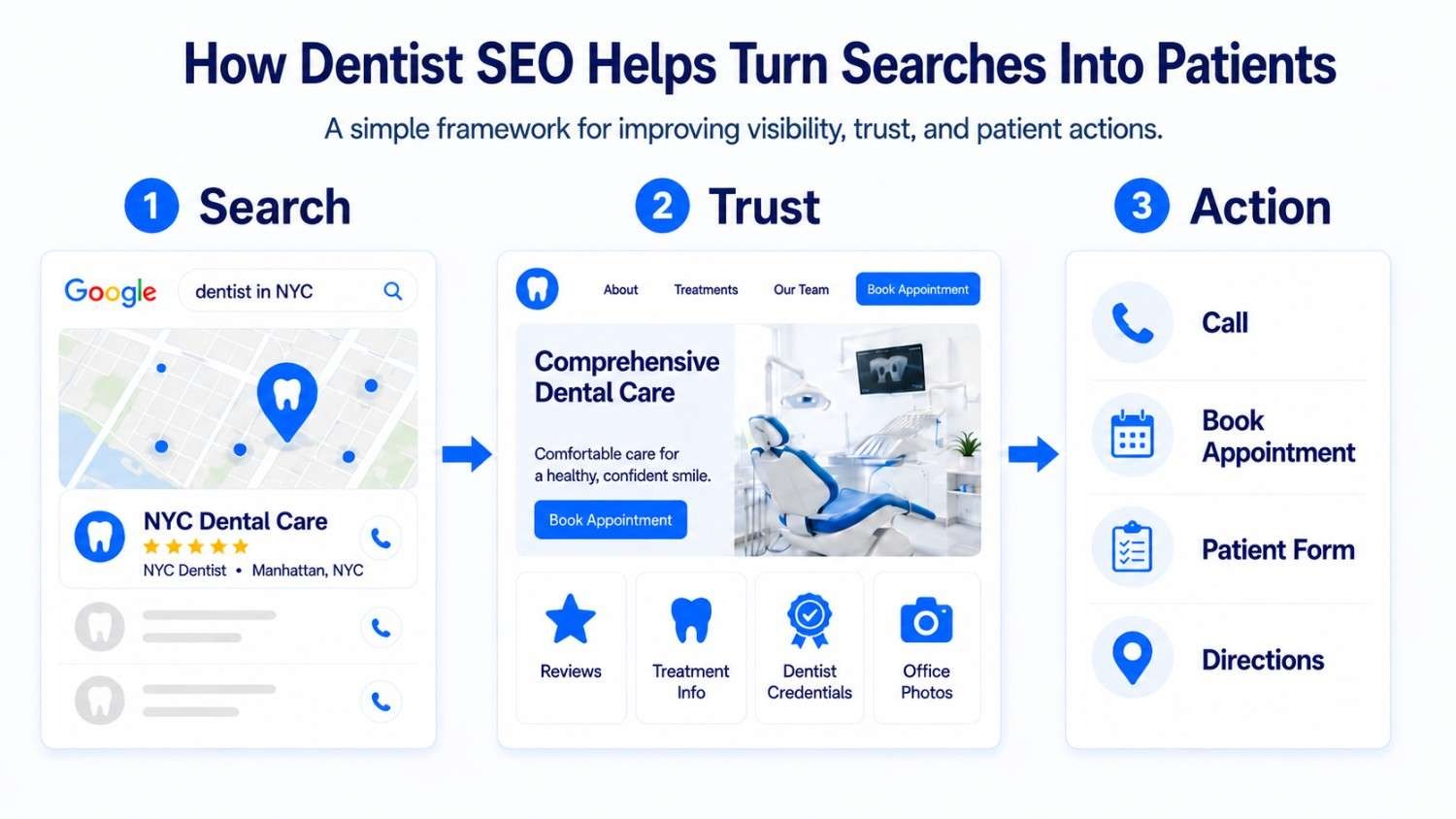
SEO for dentists helps dental practices appear when people search Google for nearby dentists, specific treatments, and answers to dental questions. Better search visibility can attract relevant visitors, but rankings alone do not generate appointments. Patients also need useful treatment information, trustworthy professional details, and convenient ways to contact a practice.
A successful dental SEO strategy combines keyword research, local search optimization, helpful website content, and technical improvements. A well-planned search engine optimization strategy helps practices connect these activities with their organic growth goals. Here are 10 practical strategies to improve your online visibility and attract potential patients.
What Is SEO for Dentists?
SEO for dentists is the process of improving a dental practice's website and online presence to increase visibility in unpaid search results. It includes keyword research, local SEO, on-page optimization, technical SEO, content development, and reputation management.
The objective is to help potential patients discover relevant dental services when they search online.
Why Dental SEO Matters
Patients often compare several dental practices before choosing one. They may check treatment options, read reviews, examine professional credentials, and compare locations before requesting an appointment.
A well-planned SEO strategy helps practices appear during this decision-making process. It can attract people searching for specific treatments, answer common questions, and make important business information easier to find.
However, more traffic does not automatically mean more patients. Relevant inquiries and booked appointments are better indicators of business value.
How Patients Search for Dentists Online
Consider someone researching dental implants:
- Searches Google for "how much do dental implants cost?"
- Reads an educational article about the procedure.
- Visits a dental implant service page.
- Checks reviews, professional credentials, and treatment information.
- Contacts the practice to arrange a consultation.
Each stage requires different content. Educational articles answer questions, treatment pages explain services, and accurate business information helps patients make decisions.
10 Effective SEO Strategies for Dental Practices
1. Research Keywords Based on Patient Search Intent
Keyword research helps dentists understand what potential patients search for and which website pages should target those queries.
Start by grouping keywords according to search intent.
| Keyword type | Example | Recommended page |
|---|---|---|
| Treatment | Dental implants | Treatment page |
| Local | Dentist in Austin, TX | Location page |
| Emergency | Emergency dentist near me | Emergency dental page |
| Informational | How much do dental implants cost? | Educational blog |
| Comparison | Invisalign vs. braces | Comparison article |
Use keyword research tools to examine search demand, competition, and related terms. However, search volume should not be your only consideration. Specific treatment keywords may attract more qualified visitors than broad searches such as "dentist."
Assign each important search intent to an appropriate page. Check existing URLs before creating new content to avoid unnecessary duplication and keyword cannibalization.
A balanced dental SEO strategy should include treatment pages, educational articles, FAQs, and location pages.
2. Optimize Your Google Business Profile
A complete Google Business Profile helps patients discover a dental practice through Google Search and Maps.
Focus on these improvements:
- Select the most accurate primary business category.
- Add relevant secondary categories.
- Maintain accurate business hours, address, and phone number.
- List the services the practice actually provides.
- Upload authentic photographs of the office and dental team.
- Keep website and appointment links accurate.
- Review profile information regularly.
Google identifies relevance, distance, and prominence as major factors influencing local search results. A complete profile helps Google understand the business, but no optimization guarantees a particular ranking.
For multi-location practices, maintain separate, accurate profiles for eligible physical locations.
3. Build and Manage Genuine Patient Reviews
Reviews help potential patients evaluate a dental practice before making contact. A consistent process for requesting honest feedback can strengthen the practice's online reputation.
For example, practices can send a neutral follow-up message after an appointment with a link to their Google review page.
Effective review management includes:
- Making it easy for patients to leave feedback.
- Responding professionally to positive and negative reviews.
- Addressing recurring concerns about communication or service.
- Avoiding arguments or defensive responses.
- Protecting patient privacy in public replies.
Never purchase reviews, offer rewards for positive ratings, or selectively request feedback only from satisfied patients. Also, avoid confirming someone's patient status or discussing treatment details in public responses.
4. Create Useful Location-Specific Pages
Dental practices with multiple offices can benefit from dedicated location pages.
Each page should include:
- The actual office address and phone number.
- Accurate opening hours.
- Services available at that location.
- Directions and accessibility information.
- Genuine photographs of the office.
- Information about the local dental team.
- A clear appointment or contact option.
For example, a practice with offices in Austin and Round Rock should provide useful information about both locations rather than publishing identical pages with different city names.
Avoid creating multiple near-identical pages for areas where the practice has no genuine presence.
5. Create Dedicated Dental Treatment Pages
One general services page is rarely enough to explain every treatment a dental practice offers.
Create dedicated pages for important services, such as:
- Dental implants
- Invisalign and orthodontics
- Teeth whitening
- Root canal treatment
- Cosmetic dentistry
- Emergency dental care
- Preventive dental services
Each page should explain the treatment, who may be suitable for it, the general procedure, important considerations, and how to arrange a consultation.
For example, a cosmetic dentistry practice targeting "teeth whitening in Austin" should create a dedicated treatment page explaining the procedure and consultation options. The page can link naturally to relevant business information and related services.
Dedicated pages help visitors find specific information instead of navigating through a generic list of treatments.
Have clinical claims reviewed by an appropriately qualified dental professional. Avoid guaranteeing treatment outcomes.
6. Improve On-Page SEO and Website Experience
On-page SEO helps search engines and visitors understand individual website pages.
Start with descriptive title tags and H1 headings that accurately explain the page's subject.
For example:
Weak: Dental Services | Our Practice
Improved: Dental Implants in Austin, TX | Practice Name
Other important improvements include:
- Write unique, relevant meta descriptions.
- Organize information using descriptive H2 and H3 headings.
- Include related keywords naturally.
- Link relevant articles to treatment pages.
- Use descriptive image filenames and meaningful alt text.
- Make appointment options easy to find.
Website experience also influences whether visitors contact a practice. Make phone numbers clickable, keep forms simple, and display appointment buttons near important treatment information.
A website's structure, page speed, mobile usability, and navigation all contribute to the visitor experience, making website optimization an important part of improving both usability and search performance.
A visitor should not have to navigate several pages to find out how to arrange a consultation.
7. Improve Technical SEO and Website Performance
Technical SEO helps search engines access, understand, and index important pages.
Regularly check the following:
- Indexability: Important treatment and location pages should not be accidentally blocked or marked noindex.
- XML sitemap: Include preferred, indexable URLs.
- Canonical tags: Specify the preferred URL when duplicate page versions exist.
- Mobile usability: Ensure navigation, contact details, and forms work properly on smartphones.
- Core Web Vitals: Monitor loading performance, interaction responsiveness, and visual stability.
- HTTPS: Maintain secure website connections.
- Broken links: Fix links that lead to missing pages.
Where appropriate, implement accurate LocalBusiness structured data and validate it before publishing.
These technical issues should be reviewed alongside existing page quality. A thorough website content audit can also reveal outdated information, duplicate pages, weak internal links, and content gaps that need attention.
Technical improvements do not automatically guarantee better rankings, but unresolved problems can prevent important pages from being discovered or understood correctly.
8. Publish Helpful, Patient-Focused Dental Content
Educational content helps practices answer questions people research before contacting a dentist.
Useful article topics include:
- How Much Do Dental Implants Cost?
- What Happens During a Root Canal?
- Invisalign vs. Braces: What Is the Difference?
- How Long Does Professional Teeth Whitening Last?
- What Should You Expect During a Dental Consultation?
Choose topics based on genuine patient questions and the services the practice offers.
Each article should provide accurate information, explain relevant considerations, and link to appropriate treatment pages where useful.
Because dental content involves health-related information, clinical explanations should be reviewed by qualified professionals and supported by reliable references where appropriate. Avoid exaggerated claims and generic articles created only to target keywords.
9. Build Local Authority and Relevant Backlinks
Local authority involves more than submitting a dental practice to hundreds of directories.
Start by maintaining accurate business information across relevant platforms. Check that the practice's name, address, phone number, and website details are consistent.
Other worthwhile activities include:
- Maintaining accurate professional association listings.
- Participating in legitimate local business organizations.
- Contributing useful content to relevant publications.
- Earning editorial mentions from reputable local websites.
- Building relationships with community organizations.
Backlinks can help search engines understand connections between websites, but relevance and editorial credibility matter more than simply increasing link counts.
Avoid paid link schemes, automated submissions, and irrelevant guest posts created primarily to manipulate rankings.
10. Track SEO Performance and Patient Inquiries
A dental SEO campaign should be evaluated using business outcomes, not just keyword positions.
Use Google Search Console to monitor:
- Organic impressions and clicks.
- Click-through rate.
- Average search position.
- Queries bringing visitors to the website.
Use Google Analytics 4 to measure organic landing-page traffic and relevant conversion events.
Also track:
- Website-generated phone calls.
- Appointment request submissions.
- Consultation inquiries.
- Qualified patient leads.
- Booked appointments.
Combining search visibility, organic traffic, and conversion data makes it easier to understand campaign performance and identify areas that need improvement through SEO reporting.
For example, a dental implants page might attract fewer visitors than a general dentistry article but generate more consultation requests. This is why traffic quality matters more than traffic volume alone.
Use call tracking and appointment measurement carefully, with appropriate privacy safeguards and consent.
SEO for Dentists vs. Traditional Dental Marketing
SEO is one part of a broader dental marketing strategy. Different channels serve different purposes.
| Marketing method | Main benefit | Main limitation |
|---|---|---|
| SEO | Long-term organic visibility | Requires ongoing work |
| PPC advertising | Targeted traffic quickly | Depends on advertising spend |
| Social media | Brand awareness and engagement | Not every interaction generates appointments |
| Patient referrals | Trusted recommendations | Depends on existing relationships |
These channels can complement one another. Paid advertising may support immediate visibility while SEO develops longer-term organic opportunities.
Common Dental SEO Mistakes to Avoid
Avoid these common mistakes when optimizing a dental website:
- Targeting only broad keywords such as "dentist."
- Publishing duplicate treatment pages.
- Neglecting Google Business Profile updates.
- Buying reviews or backlinks.
- Ignoring mobile usability and technical problems.
- Creating location pages without genuine local information.
- Publishing clinical content without professional review.
- Measuring success through rankings alone.
Regularly review website content, business information, and performance data to identify problems and opportunities.
How Dentists Should Choose an SEO Company
Choosing the right SEO partner can help dental practices improve search visibility, attract relevant patients, and measure marketing performance. Before hiring an agency, dentists should evaluate its experience, optimization methods, reporting process, and understanding of local search.
Consider these factors when comparing SEO companies:
- Dental industry experience: Look for an agency that understands dental services, local competition, and patient search behavior.
- Keyword research: Ask how it identifies treatment-specific and location-based keywords for your practice.
- Technical SEO: Check whether the agency can identify indexing issues, website performance problems, and structural weaknesses.
- Local SEO: Understand how it approaches Google Business Profile optimization, local pages, reviews, and relevant citations.
- Content quality: Ask how it develops accurate treatment pages and patient-focused articles.
- Performance reporting: Make sure reports cover organic traffic, keyword visibility, qualified inquiries, and appointment requests.
Dental practices can manage SEO themselves, hire an in-house marketer, or work with an external agency. An agency offering broader digital marketing services may also help coordinate SEO with paid advertising, content marketing, and other activities that support patient acquisition. The right option depends on the practice's budget, available time, and marketing requirements.
Avoid companies promising guaranteed Google rankings or relying on questionable link-building tactics. A reliable SEO partner should explain its strategy, deliverables, and expected limitations clearly.
Final Thoughts
Effective SEO for dentists combines keyword research, local search optimization, useful treatment pages, technical improvements, and trustworthy content. The objective is not simply to rank for more keywords but to help relevant people discover a practice, understand its services, and make informed appointment decisions. By monitoring organic performance alongside qualified inquiries and booked consultations, dental practices can make better marketing decisions and build sustainable search visibility.