Building and maintaining an in-house software development team in the United States can require a significant investment in salaries, recruitment, employee benefits, and technical infrastructure. For startups and established businesses alike, these expenses can make it difficult to develop new products while managing operating costs.
This is one reason US companies outsource software development. By working with external development partners, businesses can access experienced engineers, obtain specialized technical skills, adjust team sizes according to project requirements, and manage development budgets more flexibly.
However, outsourcing is not just about finding developers at lower hourly rates. It also gives companies access to different engagement models, including dedicated development teams, offshore development, and staff augmentation.
In this guide, we'll explore why US businesses choose software development outsourcing, how much it can cost, the benefits and potential risks, and what to consider when selecting a reliable development partner.
Why US Companies Outsource Software Development
US companies outsource software development to access technical expertise, manage development expenses, and respond to changing business requirements without relying entirely on in-house teams.
Finding and retaining experienced software developers in the United States can be expensive and time-consuming, particularly when businesses need specialized skills or additional development resources. Outsourcing provides an alternative by connecting companies with external development teams that can support their technical requirements.
The main reasons US businesses choose software development outsourcing include:
- Managing Development Expenses: Reduce the financial commitments associated with permanent hiring and maintaining internal teams.
- Accessing Specialized Talent: Find developers with the technical skills required for specific projects.
- Reducing Recruitment Delays: Get access to external development resources without managing lengthy hiring processes.
- Increasing Development Capacity: Add technical resources when project requirements or workloads increase.
- Supporting Digital Transformation: Access expertise in modern technologies to develop and improve business software.
The following table summarizes how outsourcing addresses common business challenges:
| Business Challenge | How Outsourcing Helps |
|---|---|
| Limited internal expertise | Provides access to external specialists |
| High recruitment costs | Reduces reliance on permanent hiring |
| Tight development timelines | Makes additional resources available |
| Changing project requirements | Allows flexible team scaling |
| Need for specialized technology | Connects businesses with experienced developers |
These factors make outsourcing a practical option for US businesses looking to manage technical requirements while maintaining operational flexibility.
The Hidden Cost of Building Software Teams in the US
Building an in-house software development team in the United States involves more than paying developer salaries. Businesses must also cover recruitment, employee benefits, training, infrastructure, software licenses, and ongoing management expenses.
The main costs include:
- Recruitment and Hiring: Job advertisements, interviews, and recruitment fees.
- Employee Benefits: Health insurance, paid leave, and retirement contributions.
- Training and Onboarding: Preparing developers to work with company systems and processes.
- Infrastructure and Tools: Computers, office facilities, software licenses, and cloud services.
- Management and Retention: Project oversight, employee development, and retention expenses.
Experienced software engineers can also command six-figure annual salaries in the US, with additional costs for specialized roles such as AI engineers, cloud architects, cybersecurity experts, and DevOps specialists.
For startups and growing businesses, these expenses can place considerable pressure on development budgets. As a result, many companies explore software development outsourcing to access the technical expertise they need without expanding their permanent workforce.
Key Benefits of Software Development Outsourcing
Reduce Development Costs Without Sacrificing Quality
One of the biggest benefits of software development outsourcing is the ability to manage development expenses without compromising quality.
Businesses can reduce recruitment, onboarding, infrastructure, and long-term staffing costs while choosing flexible engagement models such as dedicated development teams, staff augmentation, and project-based pricing.
However, choosing the cheapest provider does not always deliver the best value. Technical expertise, code quality, and long-term support should also influence the decision.
The savings can be redirected toward product innovation, marketing, and business expansion.
Access Global Software Engineering Talent
Software projects often require specialized technical skills that may be difficult or expensive to find locally.
Through offshore software development, US businesses can access professionals experienced in:
- Artificial intelligence and machine learning
- Cloud computing and DevOps
- Mobile application development
- Cybersecurity
- Enterprise software
- Data analytics
For example, a company developing an AI-powered SaaS platform may need machine learning engineers, backend developers, cloud specialists, and QA engineers. An outsourcing partner can help assemble a team with the expertise required for the project.
Launch Products Faster
Recruiting and onboarding an internal development team can delay projects and increase initial costs.
Software development outsourcing allows businesses to access technical resources without hiring every specialist individually.
For example, a startup preparing to launch a SaaS product may need developers, UI/UX designers, and QA engineers. An outsourcing partner can provide these professionals to support development, testing, and launch preparation.
This helps businesses reduce recruitment delays and bring products to market more efficiently.
Scale Development Teams Easily
Software development requirements often change throughout a project's lifecycle. Outsourcing allows businesses to adjust team capacity according to their workload and technical needs.
For example:
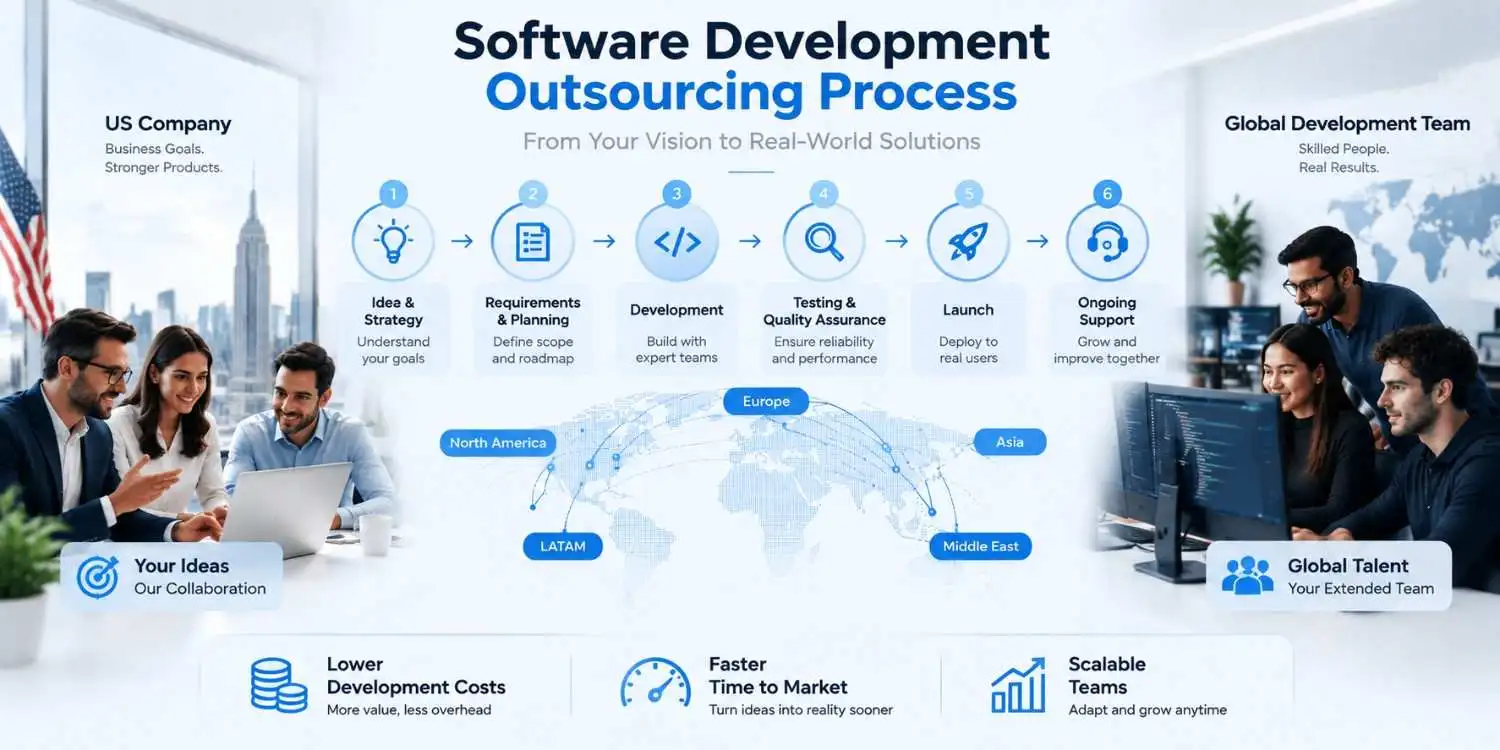
- Initial stage: Start with a small team to build the core product.
- Development stage: Add developers and QA engineers as requirements grow.
- Launch stage: Increase testing and deployment support.
- Maintenance stage: Adjust resources for ongoing updates and support.
This flexibility helps startups, growing businesses, and enterprises manage changing development needs without committing to permanent hiring for every project.
Software Development Outsourcing Cost in 2026
Software development outsourcing costs depend on project complexity, developer experience, technical requirements, and the location of the development team. US businesses can choose between individual developers, outsourcing agencies, and dedicated development teams.
Average Software Development Outsourcing Rates by Region
The following figures provide indicative pricing benchmarks for 2026:
| Region | Junior Developer | Senior Developer |
|---|---|---|
| United States | $50–$99* | Varies by provider |
| Europe | $31–$39 | $64–$76 |
| Latin America | $33–$45 | $60–$75 |
| Asia | $24–$31 | $31–$41 |
US figures represent Clutch agency pricing bands, while other figures are developer-rate benchmarks from Accelerance. These are not directly comparable rates.
Actual costs vary based on technical expertise, project scope, team size, and engagement model.
Common Software Development Pricing Models
- Fixed-Price: An agreed total cost for projects with clearly defined requirements and deliverables.
- Time and Materials: Payment based on actual development hours and resources used, offering flexibility when requirements change.
- Dedicated Team: A recurring cost for an assigned development team, suitable for ongoing projects.
Businesses should compare pricing, included services, quality assurance, and maintenance responsibilities before selecting an outsourcing partner.
Software Outsourcing vs Building a Remote Development Team
Remote hiring has become popular, but it is different from working with a software development partner.
| Factor | Outsourcing Partner | Remote Hiring |
|---|---|---|
| Recruitment | Managed by provider | Company handles hiring |
| Team Management | Shared responsibility | Fully internal |
| Scaling | Faster and easier | Requires additional hiring |
| Expertise | Access existing specialists | Depends on successful recruitment |
| Project Support | Often includes management and QA | Usually handled internally |
For companies without a large technology management structure, outsourcing can provide a more complete solution.
Popular Software Development Outsourcing Models
Businesses can choose different software outsourcing models depending on their goals, budget, technical requirements, and level of collaboration needed. The most common models include offshore development, nearshore development, dedicated development teams, and staff augmentation.
Offshore Software Development
Offshore software development involves working with development teams located in different countries, often to access a larger talent pool and optimize development costs.
Key advantages include:
- Access to Global Talent: Businesses can work with skilled developers who have experience in different technologies and industries.
- Cost Efficiency: Offshore teams can help companies reduce development expenses while maintaining access to qualified technical professionals.
- Specialized Expertise: Companies can quickly find experts in areas such as AI, cloud computing, cybersecurity, and enterprise software.
Best suited for: Startups and businesses that need specialized skills, cost flexibility, or long-term development support.
Nearshore Software Development
Nearshore outsourcing connects businesses with software development teams in nearby countries or regions, allowing easier collaboration through closer time zones and cultural alignment.
Key advantages include:
- Better Communication: Similar working hours make meetings, updates, and collaboration easier.
- Cultural Compatibility: Teams often have similar business practices and communication styles.
- Faster Coordination: Reduced time-zone differences can improve project management and delivery speed.
Best suited for: Companies that want outsourcing benefits while maintaining closer collaboration with their development teams.
Dedicated Development Teams
A dedicated development team works as an extension of a company's internal team, providing long-term technical resources without the complexity of traditional hiring.
A typical dedicated team may include:
- Software developers
- UI/UX designers
- QA engineers
- Project managers
- Technical specialists
Key advantages include:
- Flexible team scaling based on project needs
- Better control over development processes
- Continuous support for long-term products
Best suited for: SaaS companies, startups, and enterprises building complex software products that require ongoing development and improvement.
Staff Augmentation
Staff augmentation allows businesses to add external developers or specialists to their existing teams for specific projects or skill requirements.
Key advantages include:
- Quickly fill technical skill gaps
- Increase development capacity when needed
- Maintain control over internal project management
Best suited for: Companies that already have an internal development team but need additional expertise or resources for faster execution.
Choosing the right outsourcing model depends on business objectives, project complexity, available resources, and the level of control required. A reliable software development partner can help companies select the model that best supports their long-term technology goals.
Common Mistakes US Companies Make When Outsourcing Software Development
Software development outsourcing can deliver significant business value, but poor planning and partner selection can lead to unnecessary costs, delays, and security risks. US companies should avoid these common mistakes to build successful outsourcing partnerships.
Choosing Only Based on Price
Selecting a provider solely because of low hourly rates can result in poor code quality, missed deadlines, and unexpected expenses. Instead, evaluate technical expertise, relevant project experience, quality assurance processes, and long-term support before making a decision.
Poor Project Requirements and Planning
Unclear project requirements often lead to scope changes, budget overruns, and development delays. Businesses should establish clear technical specifications, feature priorities, project milestones, and acceptance criteria before development begins.
Ignoring Security and Compliance
Outsourcing may involve sharing sensitive business information, customer data, and source code. Companies should verify security practices, access controls, confidentiality agreements, data protection responsibilities, and intellectual property ownership before signing a contract.
Poor Communication and Collaboration
Time-zone differences, unclear responsibilities, and inconsistent updates can disrupt development. Establish designated communication channels, regular progress meetings, shared project management tools, and clear reporting expectations to keep teams aligned.
Ignoring Long-Term Support
Software development does not end at launch. Applications require ongoing maintenance, security updates, bug fixes, and performance improvements. Before choosing a provider, clarify maintenance responsibilities, support arrangements, and post-launch service agreements.
How AI Is Changing Software Development Outsourcing in 2026
Artificial intelligence is changing how software development teams build, test, and maintain applications. US businesses are increasingly working with outsourcing partners that use AI-powered tools to improve development workflows and automate repetitive tasks.
AI-assisted development tools can help teams:
- Generate and review code.
- Automate software testing.
- Identify bugs and assist debugging.
- Create technical documentation.
- Accelerate application prototyping.
However, AI does not replace experienced software engineers. Human expertise remains essential for software architecture, security, code validation, and meeting business requirements.
When choosing an outsourcing partner, businesses should evaluate its AI development practices, human code review processes, security measures, and quality assurance standards.
Combining AI-assisted tools with experienced developers and reliable processes can help businesses build and maintain software more effectively.
How to Choose the Right Software Development Partner
Choosing the right software development partner is critical for outsourcing success. Businesses should look beyond pricing and evaluate technical expertise, reliability, communication, and long-term value.
- Technical Experience: Choose a partner with proven expertise in relevant technologies, industries, and software solutions. Their experience should match your project requirements and business goals.
- Portfolio and Case Studies: Review previous projects, client results, and case studies to understand their ability to solve real business challenges and deliver quality solutions.
- Communication Process: Strong collaboration requires clear communication channels, regular updates, transparent reporting, and effective project management throughout development.
- Security and Compliance: Ensure the partner follows proper security practices, protects intellectual property, and understands data protection requirements relevant to your industry.
- Development Methodology: Experienced teams use structured approaches such as Agile, Scrum, and DevOps to improve planning, quality control, flexibility, and delivery speed.
- Pricing Transparency: Select a partner that provides clear pricing, realistic estimates, and focuses on long-term value instead of only offering the lowest cost.
- Long-Term Support: A reliable technology partner should provide ongoing maintenance, improvements, and scalability support to help your software grow over time.
Why Zensol Global Technologies Helps Businesses Build Scalable Software Solutions
Selecting the right technology partner can significantly impact software success.
Zensol Global Technologies helps businesses develop scalable digital solutions by combining software engineering expertise, modern development practices, and business-focused strategies.
From custom software development and SaaS platforms to enterprise applications and digital transformation solutions, the right technology partner helps companies turn ideas into reliable products.
A successful outsourcing relationship is not just about writing code. It is about creating technology that supports business growth.
Final Thoughts
The increasing cost of hiring developers, shortage of specialized talent, and demand for faster innovation explain why US companies outsource software development.
Modern outsourcing is no longer only a cost-saving strategy. It has become a powerful way for businesses to access global expertise, accelerate digital transformation, and build competitive software products.
By choosing the right software development partner, companies can overcome technical challenges, reduce development risks, and create scalable solutions that support long-term growth.
If your business is looking for a reliable technology partner, contact ZENSOL Technologies to discuss your software development goals.